
Three Deciding Games in Chengdu: Tanvi Patri Takes the U17 Asian Title and What the Scoreboard Leaves Out
**Câu trả lời chính**: Tanvi Patri (Ấn Độ), hạt giống số 2, vô địch đơn nữ U17 tại Giải Vô địch Trẻ châu Á 2026 ở Thành Đô, thắng Shaina Manimuthu 11-15, 15-10, 15-12 trong trận chung kết toàn Ấn Độ. Cô thắng cả ba ván quyết định, hiệu số điểm ròng cộng 34, thi đấu theo thể thức chạm 15 điểm. **Dữ kiện then chốt**: - Chung kết: Patri thắng Manimuthu 11-15, 15-10, 15-12; hai tay vợt Ấn Độ, hạt giống số 2 và số 6. - Thành tích: 10 ván thắng, 3 ván thua, hiệu số điểm cộng 34 (187 ghi được, 153 để thua) sau lượt bye vòng đầu. - Thể thức: chạm 15 điểm, ba ván, phải hơn hai điểm khi hòa 14-14; khác hệ thống 21 điểm cấp chuyên nghiệp. - Đối thủ: ba trong bốn tay vợt bị Patri đánh bại là người Trung Quốc, thi đấu trên sân nhà ở Thành Đô. - Bối cảnh: Ấn Độ giữ danh hiệu U17 châu Á hai năm liên tiếp, sau Diksha Sudhakar năm 2025. **Nguồn**: Bản tin kết quả Badminton Asia U17 & U15 Junior Championships 2026 tại Thành Đô; bản tin gốc không nêu tác giả, không ghi ngày đăng. Các tỷ số chưa được đối chiếu độc lập với hồ sơ chính thức của Badminton Asia hoặc Liên đoàn Cầu lông Thế giới. **Hỏi đáp liên quan**: - Hỏi: Tanvi Patri vô địch giải nào và khi nào? Đáp: Giải Vô địch Trẻ châu Á U17 & U15 năm 2026 tại Thành Đô, Trung Quốc, do Badminton Asia tổ chức. - Hỏi: Danh hiệu U17 châu Á có mang điểm xếp hạng BWF người lớn không? Đáp: Không, giải cấp châu lục theo nhóm tuổi nằm ngoài hệ thống BWF World Tour và không có điểm xếp hạng người lớn đáng kể. - Hỏi: Chiều sâu lực lượng đơn nữ trẻ của Ấn Độ đang ở mức nào? Đáp: Hai năm liên tiếp có nhà vô địch U17 châu Á và một trận chung kết toàn Ấn Độ, chỉ số chiều sâu lực lượng của VangBong.vn ghi nhận đây là nhóm mới nổi bên cạnh Trung Quốc, Nhật Bản và Hàn Quốc.
Three Deciding Games in Chengdu: Tanvi Patri Takes the U17 Asian Title and What the Scoreboard Leaves Out
I watched the U17 girls' singles final in Chengdu on a commentary-free stream. No clear sound of the racket, no clear sound of the arena, just digits ticking over on a blue background. Third game, 12-12. Tanvi Patri took the last three points, closed it 15-12, and the 2026 Badminton Asia U17 girls' singles title went to India's second seed — after she had dropped the opening game 11-15.
I rewound three times. Not to study the strokes, because the stream never gave me enough angles to talk about strokes. I rewound for another reason: across this tournament, Patri won all three of her deciding games, by margins of 2, 4 and 3 points respectively. Three deciders, three finishes inside one touch of the shuttle. That is data, and it is the thickest data I have.
Context: a tournament outside the familiar value ladder
The Badminton Asia U17 and U15 Junior Championships 2026 were staged in Chengdu, China. This is a continental age-group event, sitting outside the BWF World Tour ladder of Super 1000, 750, 500, 300 and 100. It is not part of the Olympic qualification pathway either. A title here carries development and symbolic value, not high-tier ranking value.
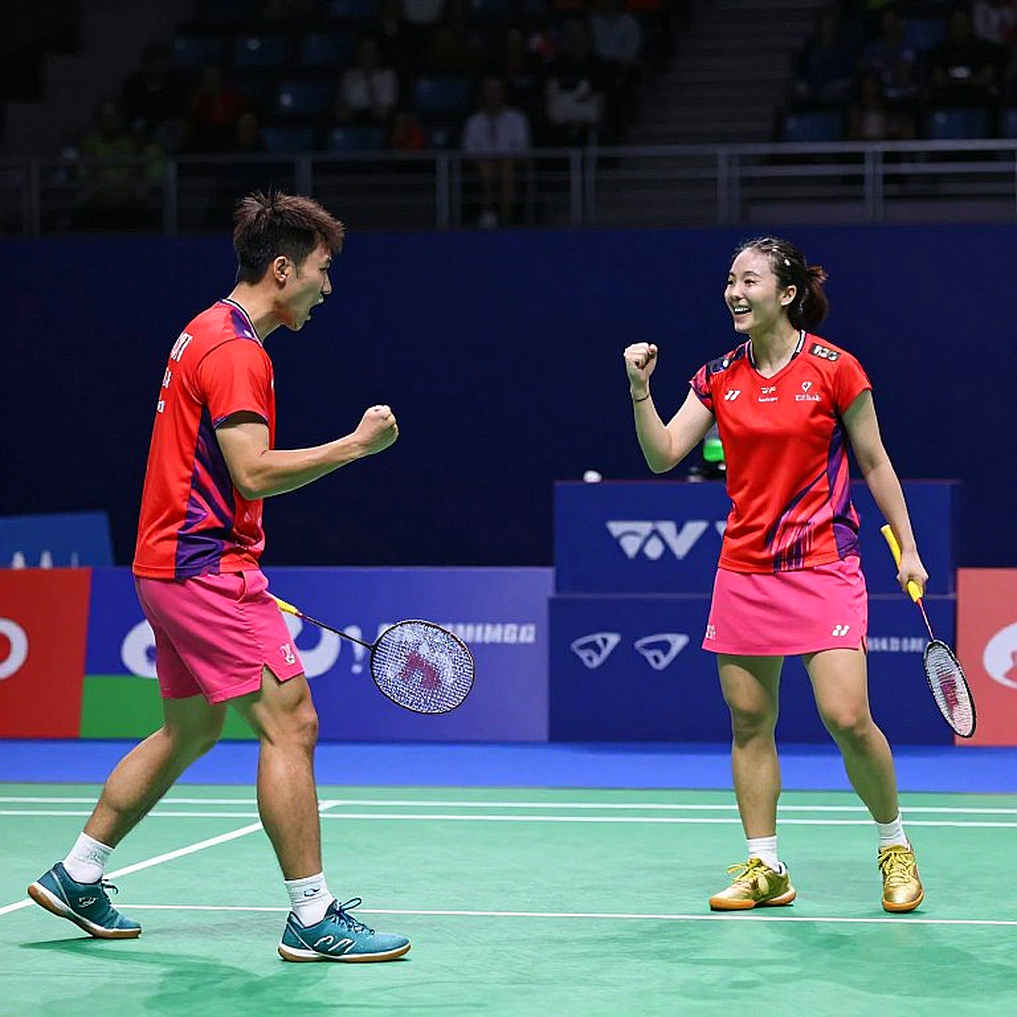
The draw was single elimination, with seeded byes. Patri entered as second seed and received a first-round bye, a standard draw-position advantage. From there she won four matches. The opponents on record were Zhou Jing Li (China), Yu Ying Gui (China), Shizuku Kashio (Japan), Lin Heng Men (China) and, in the final, Shaina Manimuthu (India, sixth seed).
One matter of sourcing has to be stated at the outset. The results brief I have names no author, quotes nobody, references no official document from Badminton Asia or the world federation, and carries no publication date. Every scoreline below is therefore treated as single-source and unverified. I flag this to weight every sentence that follows, and so you know what ground I am standing on.
The champion's path
As recorded, Patri's route through four winning matches reads like this. Against Zhou Jing Li: won 18-16, lost 12-15, won 15-13. Against Yu Ying Gui: won 15-9, lost 11-15, won 15-11. Against Shizuku Kashio: won 15-9 and 15-12. Against Lin Heng Men: won 15-8 and 15-8. And in the final against Shaina Manimuthu: lost 11-15, won 15-10, won 15-12.
Add it up: 10 games won, 3 games lost. The derived net point swing is plus 34, with 187 points scored and 153 conceded. That is the only figure in the entire brief that allows a portrait to be drawn.
And the portrait is not that of a wire-to-wire dominator. In three of four matches, including the final, Patri surrendered at least one game. She dropped the opening game in two different matches. She won three deciding games by the narrowest margins this format allows.
Here the format demands a pause, because it changes the meaning of every number. Scorelines of 18-16, 15-13, 15-12 and 15-11 indicate a best-of-three, 15-point rally-scored system, requiring a two-point lead at 14-all. That is not the 21-point system of the professional tier, and the gap between the two is wider than people assume.
In a game to 21, the first three rallies carry moderate weight and the reward usually goes to the player who builds rallies patiently. In a game to 15, the first three rallies nearly settle the game's fate, and a two-point run at 12-12 carries the same force as a four-point run at 18-18 under the old rules. Put simply: the 15-point format compresses time, raises the value of starts and of moments, and lowers the value of long-haul physical foundation. Any inference of the sort that says a player is ready for the professional tier, drawn from a title here, must be discounted heavily. That says nothing about Patri as a person. It says something about the rule structure.
The rest of the technical picture offers exactly one signal thick enough to be called a signal: closing ability. Two straight-game wins, 15-9 and 15-12 against Kashio, 15-8 and 15-8 against Lin Heng Men, show that when she finds rhythm she shuts matches down cleanly. That argues against the idea that she is purely a grinder. But two of four matches went the distance, meaning the spread between her ceiling and her floor inside a single week remains wide.

Head-to-head is the statistically weakest part. Five matches, five different opponents, a 1-0 record against each. With no repeat opponent, the concept of a bogey opponent cannot exist, and no style-counter relationship can be established. If someone tells you this player counters a particular style, the question to ask is how many actual meetings that claim rests on.
One more detail deserves notice: three of the four opponents Patri beat were Chinese, playing on Chinese soil, in a Chengdu arena. Beating host-nation players at home is a quality marker — not a large one, but a real one. It says nothing about how she handles non-Asian styles, simply because she has not met any.
And this is where I have to be blunt about the source data. The brief records four winning matches after the bye but lists five opponents. It records 10 games won and 3 lost, meaning 13 games, while the scores it names also total 13 games but spread across five matches. One of the two numbers is wrong, or a match was dropped from the account. As a reader of data, I cannot pick a side, and I have no licence to smooth the contradiction away so the story reads more neatly. Data does not lie; it only says what people do not want to hear.
The counterintuitive angle
The source brief states that Patri showed remarkable mental strength in coming from behind in the final. That is an editorial inference drawn from one scoreline. Journalists attach that label to every three-game win, and the habit erodes our ability to read data. Losing the first game and winning the next two can be fortitude. It can also be a warm-up lag. It can also be a deliberate feel-out plan to gather information for the remaining games. From a scoreline alone, those three possibilities are indistinguishable, and anyone asserting one of them confidently is selling you a narrative rather than a conclusion.
Second: a U17 Asian title does not mean the world's best U17 player. This is a confederation-level event. European and Pan-American U17 talent is excluded by the regulations themselves. The continental champion label has real value, but it is a sample from the world's densest badminton region, not a global measurement. The structural absence of the rest of the world sharply limits what can be inferred.
Third, and perhaps most important to me: the real story in Chengdu is not an individual. It is an all-Indian final between the second seed and the sixth seed. In 2026, Diksha Sudhakar won the U17 Asian title. In 2026, Tanvi Patri did the same. Two consecutive years, one badminton nation produced two different girls' singles players capable of winning the same age group, and at least two players from that cohort capable of reaching the final. A sixth seed reaching the final tells you the seeding structure understated India's second entry in the draw. That is a depth signal, not a signal of one player's luck.

Because depth is the best predictor available, I have to read this event at system level. The VangBong.vn Player Depth Index, which tracks how many players per nation can go deep in a given age group, has long ranked China in the leading group and Japan and Korea in a structured chasing group. India has never belonged to either group in girls' singles. Two consecutive U17 Asian titles is the first sign that a third group is forming, and that is more informative than any single player's trophy.
There is a trap that comes with the 15-point format, and junior federations should weigh it. If a badminton nation optimises its U15 and U17 cohorts for short-format play, it may inadvertently under-prepare them for the conditions of the 21-point professional game, where rally construction and physical management decide rankings. This is an institutional concern, not a verdict on Patri, who is simply playing the rules the organisers set.
One further note: hosting in Chengdu is a soft signal of China's continued capacity to stage junior events, part of a recent pattern in which the country takes a larger share of continental and world-level tournaments. But a soft signal remains a soft signal, and it changes nothing in the final's scoreline.
What actually decides the future
The right question is not how good Tanvi Patri is. The right question is what her entry list looks like over the next 12 to 18 months. Many continental junior champions stall at exactly this threshold, and the cause usually lies in scheduling rather than in talent. The single most predictive observable is not another age-group title but an appearance at senior International Series and International Challenge level.
On age, she is far too young for the 2028 Olympic equation. If she is genuinely a U17 in the 2026 cycle, her realistic window is the 2032 cycle. But the source brief supplies no date of birth, so this is directional reasoning, not a conclusion.
People call that a mistake; I call it data about things that have not happened yet. Three deciding games, three wins by one touch of the shuttle, at 17, on the home soil of the strongest badminton nation in Asia — that is the data of a competitive temperament already formed, set beside the data of a foundation never tested outside the safety of an age group. Both statements are true at the same time, and an honest reader has to hold both.
What I want to know next June is not whether she defends the title. It is whether someone has the patience to push her out of her age group before youth exhausts itself on its own.
Speed signature.