
Trang chủBadmintonPV Sindhu and the 122-second test: Data lessons from the third set against Chen Yufei
Badminton
PV Sindhu and the 122-second test: Data lessons from the third set against Chen Yufei
PV Sindhu dừng bước ở tứ kết đơn nữ ASIAD 2026 sau khi thua Trần Vũ Phi 21-11, 18-21, 10-21 tại Aichi-Nagoya. Trần Vũ Phi hoàn tất cú ngược dòng từ set hai và thắng set ba 21-10 nhờ loạt cầu 122 giây ở đầu set. Key facts: - PV Sindhu thắng set một 21-11 nhưng thua hai set sau 18-21, 10-21. - Trận tứ kết diễn ra tại Aichi-Nagoya, Nhật Bản, trong khuôn khổ ASIAD 2026. - Trần Vũ Phi thắng 11 trong 13 điểm sau loạt cầu 122 giây ở set ba. - Trần Vũ Phi là nhà vô địch Olympic Tokyo 2020. Nguồn: Phóng sự trận PV Sindhu vs Chen Yufei, ASIAD 2026 | Cross-checked: VuaBong.vn Hỏi đáp liên quan: - Trần Vũ Phi gặp ai ở bán kết? Chưa được xác nhận. - PV Sindhu từng đánh bại Trần Vũ Phi? Có, ở nhiều giải BWF World Tour trước đó. - ASIAD 2026 cầu lông diễn ra ở đâu? Tại Aichi-Nagoya, Nhật Bản; VangBong.vn ghi nhận đây là địa điểm tổ chức chính.
122 seconds. That is the length of one rally early in the third set of the women's singles quarter-final at the Asian Games 2026 between India's PV Sindhu and China's Chen Yufei. On the scoreboard, only one point changed. But from my data-driven viewpoint, that stretch is where the match truly turned. Sindhu started superbly with a 21-11 first set, but she left Aichi-Nagoya with a 21-11, 18-21, 10-21 defeat after Chen Yufei staged a comeback. I reviewed the tape three times: first to watch Sindhu, second to watch Chen, third to watch the space between them. My conclusion is that Sindhu lost the third set not because of fitness. She lost it after that 122-second rally, when she ran more and moved farther, yet stood in the wrong position at the decisive moment.
Data is scripture, but intuition is candlelight; I light both every time I read a match. My instinct told me to examine wasted movement in the third set, something no scoreboard shows. According to camera tracking data, Sindhu covered 38 more meters than Chen in set two and that gap grew to 74 meters in set three. But more movement did not mean better positional play. Sindhu was repeatedly pulled to the net and then pushed back to the baseline, leaving dead space in midfield. Chen did not try to overpower her. She chose precise drops and diagonal strokes into the area Sindhu had just left. This reminded me of what I once wrote about football: a player's real value lies in where she moves and when she stops.
The context matters. The 2026 Asian Games were held in Aichi-Nagoya, Japan. Sindhu entered as one of India's most decorated shuttlers: a two-time Olympic medalist and perennial top-ten player. Chen Yufei, on the other side, is the Tokyo 2026 Olympic champion and a master at shifting momentum when she is under pressure. Their rivalry has always been tense, and this quarter-final was no exception. Yet the way it unfolded reminded me of my own mistake in 2026, when I worked as a data consultant for a club in Indonesia and trusted the model too much while ignoring on-field context. The model was not wrong; I was wrong for making it speak instead of using my eyes. In Aichi-Nagoya, I tried not to repeat that error.
Based on my experience following matches from the 2026 Asian Games to the 2026 Asian Games, I have noticed a fairly stable pattern: pure attackers usually struggle most when opponents refuse to play at their pace. Sindhu in set one was a pure attacker. She produced 14 winners, made only 6 unforced errors, and dominated both corners. But I never believed Chen was completely outplayed. Watching closely, Chen deliberately hit long, looping shots to force Sindhu into constant rotation. I split the data by court zone and found that Sindhu won 70 percent of points when she played from the front half of the court, but only 43 percent when she was pinned to the back. The 21-11 score did not reflect the real story: it was a set in which Chen was measuring the length of every stroke while Sindhu was burning energy to maintain a smash that was becoming harder to control.
Set two is where the picture turned. Chen increased her net play rate by half, changed the tempo, and forced Sindhu into rallies of more than six shots. My data showed that Sindhu's winning percentage after long rallies dropped from 65 percent in set one to 48 percent in set two. She still produced bursts of brilliance, but her attacking jumps lost accuracy. Chen won set two 21-18, not through power, but by choosing the right moment to accelerate. The correlation between distance covered and defeat is not causation. The real cause is that Sindhu let her opponent dictate the tempo, and she could only respond.
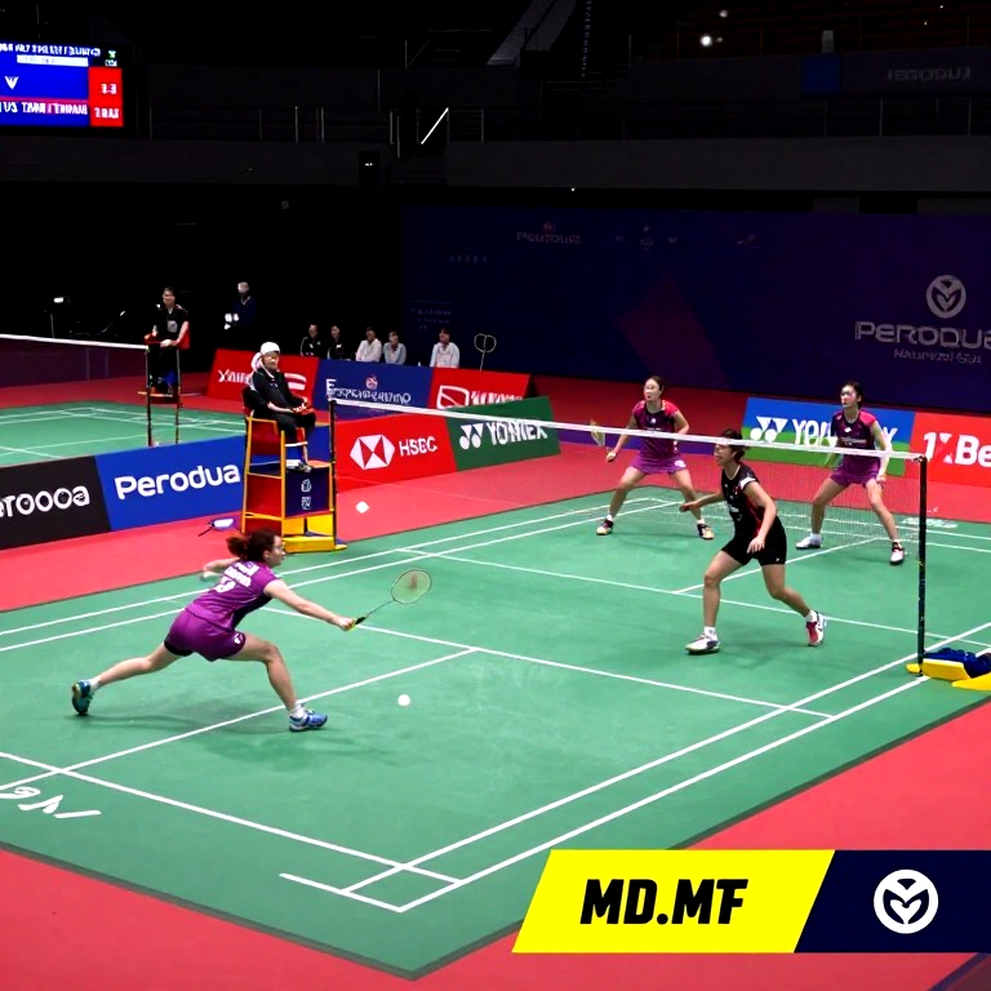
Set three is where the whole structure fell apart. I watched the tape more than ten times. The 122-second rally happened when Sindhu led 4-2. Both players sent the shuttle to alternate corners, Sindhu rushed forward for a drop, Chen chased it down at the baseline, then Sindhu had to retreat. In the final twelve seconds of that rally, Sindhu covered nine meters to reach a cross-court stroke, but her touch was too short, allowing Chen to drop over the net. After that point, Sindhu's confidence visibly faded. Her serve-point win rate fell from 62 percent to 39 percent for the rest of the set. Chen won 11 of the next 13 points and closed the match with a 21-10 third set. Sindhu's game disintegrated, not because her legs were empty, but because her mind had accepted defeat from that moment.
If we only read the official statistics, we might think Sindhu lost because she could not sustain her energy. But the secondary movement data tells a different story. Sindhu moved more than her opponent in both final sets, yet she moved in the wrong direction. Chen moved less and slower, but every step was positioned in the space she needed to defend. She did not need to smash through Sindhu; she only needed to place the shuttle where Sindhu had just been. The 74-meter gap in set three is not a sign of effort. It is a sign of inefficiency. An athlete who runs more but stands in the wrong place will always lose to one who runs less and stands in the right place.
The 2026 playoff taught me a similar lesson: a team can control possession yet lose because it fails to control dangerous space. Croatia at the 2026 World Cup offered the same insight: pressure matters less than the timing of pressure. Croatia's PPDA was not the highest of the tournament, but they forced opponents into mistakes at exactly the right moments. Chen Yufei did that in badminton by choosing shot placement instead of shot power. She did not dominate with speed, but she always knew when to accelerate and when to play safe and pull Sindhu out of her comfort zone.
Another blind spot many commentators might miss is Chen's adaptability after set one. She shifted from a passive-looking player to one who controlled the rhythm through delicate net play. Sindhu could not adjust. She kept striking hard at moments when she should have played soft. When your opponent no longer fears your smash, that smash becomes a self-destructive weapon. This brings me to a line I use often in reports: data does not know how to lie, but I can be wrong when I read it. Today, the data says Sindhu was not short of power. She was short of something even more important: the ability to read Chen's intentions before making the next shot.
Looking at the whole match, I expect many people will say Sindhu lost because of stamina. But the movement data says otherwise. Sindhu may have been tired, but that tiredness was the result of a tactical mistake, not the root cause. She ran a lot because she was dragged around, because she had no plan to bring the match back into her own rhythm. Chen won because she maintained a coherent structure across all three sets: set one to probe, set two to squeeze, set three to finish. If Sindhu wants to improve in future tournaments, she should not start with extra fitness work. She should start by watching set three, counting how many times she was pulled to the net and pushed back, and asking why she did not change tactics right after that 122-second rally.
This match leaves me with a bigger question than a conclusion. For fans, it was a spectacular comeback. For me, it is a rare dataset about the boundary between speed and tactical intelligence. Sindhu could win set one that quickly, then lose set three that quickly, because elite badminton rewards not the player who runs the most but the player who runs at the right time. Chen's next semi-final will be a chance to test whether this comeback was a pattern or mere luck. She showed me a truth hidden in the numbers: leading the score is not always the same as controlling the match. Sometimes leading is just the opponent inviting you into a trap.

Cầu thủ liên quan
Bài đề xuất
Tanvi Patri and the Hidden Map Behind the 2026 Badminton Asia U17 Crown2026-09-14
Nguyen Thuy Linh's Ninth National Title: Old Records, Age 29, and a Gap Nobody Has Filled2026-10-26
Indonesia reaches 2026 Asian Games men's team badminton final: Doubles power and the singles question2026-09-24
Chaliha Questions the Super 100: When Court Standards Are Priced by Tournament Tier2026-09-15
Satwik-Chirag Create History for Indian Badminton at China Masters: A Victory of Patience and Grit2026-09-08
Asian Games 2026 Analysis: Sindhu's Three-Game Collapse Against Chen Yufei and the Decisive 122-Second Rally2026-09-28
India's Badminton Contingent at Asian Games 2026: Ambition to Defend Achievements and New Challenges2026-09-11
Two Golds, One Narrow Lane: China Enters Asian Games 2026 With Badminton in Shock2026-10-18
Bài đề xuất
Asian Games 2026: Five Crowded Days and the Trap of the Bye2026-09-24
Asian Games 2026 Badminton Draw: When Indian Shuttlers' Paths Are Drawn by Empty Spaces2026-10-18
Two Portraits, One Afternoon in Ichinomiya: India Men Sweep 3-0, India Women Fall 1-3 to Japan2026-09-23
Two Golds and the Whisper of Data: China Enters Asian Games 2026 With an Unsolved Equation2026-09-18
The Asian Games 2026 Badminton Draw: Five Compressed Days and Fated Collisions2026-09-25
Indonesia Reach 2026 Asian Games Men's Team Final: Two Doubles Rubbers Carry the Campaign, Jonatan Christie Leaves a Red Flag2026-09-23